


Proxy Infrastructure for Every Use Case
Explore how businesses, developers, marketers, researchers, and enterprises use Proxy Grove to scale operations, collect data, automate workflows, and improve performance.
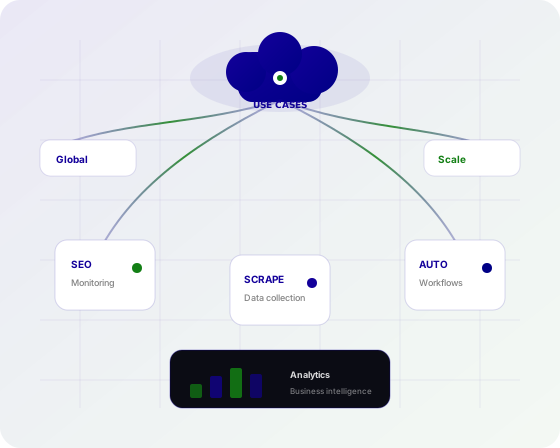
Discover workflows built for real teams
Search and filter by category—each card links to a dedicated SEO page.
Built for agencies, stores, SaaS, and enterprises
Pick an industry path to the use cases and products that fit your team.
Discover, connect, collect, analyze, scale
A clear path from use case to production proxy infrastructure.
Coverage, performance, and control in one platform
Capabilities teams rely on across SEO, research, automation, and commerce.
Network signals you can edit from admin
Qualitative and coverage metrics—no invented customer counts.
Pair every use case with the right proxy type
Jump into product pages for Mobile, Residential, and Corporate proxies.
Proxy use case questions, answered
SEO-focused answers about workflows, industries, products, and getting started.
Proxy use cases are the business and technical workflows that rely on proxy infrastructure—such as SEO monitoring, web scraping, market research, ad verification, automation, and brand protection.
SEO teams commonly use Residential and Mobile proxies for geo-accurate rank tracking and SERP checks. Choose sticky sessions when continuity matters and rotation for broader sampling.
Yes. Residential, Mobile, and Corporate proxies are frequently used for public web data collection. Always follow applicable laws and third-party terms of service.
Yes. AI and ML teams use proxies to access public web sources for research crawls, enrichment, and evaluation pipelines with controllable sessions and global coverage.
E-commerce teams monitor catalogs, marketplace listings, and public prices from regional perspectives using rotating or residential endpoints with country targeting.
Sticky sessions keep the same IP for a configured window—ideal for logins and multi-step flows. Automatic rotation changes IPs to distribute high-volume jobs across a pool.
Digital and SEO agencies, e-commerce stores, SaaS companies, research firms, marketing teams, startups, and enterprises all use proxies for monitoring, research, and automation.
Yes. Ad verification and brand protection workflows use geo-targeted proxies to check creatives, placements, and public listings across markets.
Country targeting is available across eligible products. City targeting is supported where the network provides city-level endpoints for your plan.
Start from the workflow: SEO and research often prefer Residential or Mobile; professional automation and business workloads often prefer Corporate. Explore product pages or talk to sales.
Many antidetect and browser tools connect over HTTP or SOCKS5 with username/password auth. Static, ISP, and mobile proxies are common choices for sticky identity.
Yes. Travel intelligence workflows can sample public fare and availability signals from multiple locations using residential or rotating proxies.
Yes. The Use Cases Hub at /use-cases/ lists featured workflows, industries, related products, and links to dedicated SEO pages for each use case.
Open the use case page, review recommended products, choose a plan, generate endpoints, and connect your software. Prefer guidance? Talk to sales.
Yes. Hub cards, industries, metrics, FAQs, and child page copy are designed to load from editable data objects so a future Cloud Admin Panel can update them without redesigning the UI.
SEO teams commonly use Residential and Mobile proxies for geo-accurate rank tracking and SERP checks. Choose sticky sessions when continuity matters and rotation for broader sampling.
Yes. Residential, Mobile, and Corporate proxies are frequently used for public web data collection. Always follow applicable laws and third-party terms of service.
Yes. AI and ML teams use proxies to access public web sources for research crawls, enrichment, and evaluation pipelines with controllable sessions and global coverage.
E-commerce teams monitor catalogs, marketplace listings, and public prices from regional perspectives using rotating or residential endpoints with country targeting.
Sticky sessions keep the same IP for a configured window—ideal for logins and multi-step flows. Automatic rotation changes IPs to distribute high-volume jobs across a pool.
Digital and SEO agencies, e-commerce stores, SaaS companies, research firms, marketing teams, startups, and enterprises all use proxies for monitoring, research, and automation.
Yes. Ad verification and brand protection workflows use geo-targeted proxies to check creatives, placements, and public listings across markets.
Country targeting is available across eligible products. City targeting is supported where the network provides city-level endpoints for your plan.
Start from the workflow: SEO and research often prefer Residential or Mobile; professional automation and business workloads often prefer Corporate. Explore product pages or talk to sales.
Many antidetect and browser tools connect over HTTP or SOCKS5 with username/password auth. Static, ISP, and mobile proxies are common choices for sticky identity.
Yes. Travel intelligence workflows can sample public fare and availability signals from multiple locations using residential or rotating proxies.
Yes. The Use Cases Hub at /use-cases/ lists featured workflows, industries, related products, and links to dedicated SEO pages for each use case.
Open the use case page, review recommended products, choose a plan, generate endpoints, and connect your software. Prefer guidance? Talk to sales.
Yes. Hub cards, industries, metrics, FAQs, and child page copy are designed to load from editable data objects so a future Cloud Admin Panel can update them without redesigning the UI.
Find the Right Proxy Solution for Your Business
Explore use cases, compare products, and launch with Starter to Enterprise plans.